
Concrete moisture is a potential project-killer to installers who do not allow sufficient time for freshly poured slabs to dry. Contractors have deployed various means of measuring concrete moisture content (MC) since the 1940s. However, relative humidity (RH) assessment has challenged the traditional anhydrous calcium chloride (CaCl) test in the 21st century.
The Wagner Meters Rapid RH® system allows users to assess concrete MC at 40 percent slab depth based on RH methodology. Contractors insert in situ probes into drilled concrete holes, and Smart sensors provide equilibrated MC data after 24 hours. And because the Wagner sensor remains in the concrete slab, subsequent readings can be taken instantaneously from sensor to sensor for immediate and informed decisions.
The simple question is: Does your current RH assessment method make business sense?
For Compliance
In 2002, ASTM International established ASTM F2170, the standard test method for in situ RH concrete assessment. In fact, ASTM F2170 can be used on lightweight concrete slabs, where F1869 cannot.
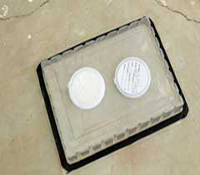 Even since being disallowed for lightweight concrete applications, ASTM F1869 is still in effect for other types of concrete slab moisture measurement according to the anhydrous CaCl test method. F1869 is based on the moisture vapor emissions rate (MVER) of concrete at the time of assessment.
Two different standards, two different tests. Which one to choose?
For Success
The Rapid RH from Wagner Meters contains several crucial features to assist concrete installers with MC management.
All concrete slabs hold a certain amount of MC at all times. The key is to assure that concrete has sufficient time to reach the RH level specified for the intended flooring application. Too high, and the risk of adhesive or flooring failure rises accordingly.
With accurate RH testing, contractors ensure the absence of excess MC in the slab. Installers can safely apply adhesives and floor coverings to appropriately dried slabs knowing they will last for the duration.
The Wagner Rapid RH provides state-of-the-art concrete moisture measurement, so contractors can have accurate information to make well-informed decisions and help ensure a successful flooring installation.
For Cost-Efficiency
 In times of intense productivity, the Wagner Meters Rapid RH also provides crucial cost savings for builders. If time is money, the Rapid RH is a recipe to meet budget targets on installation. Compared to the CaCl method, Wagner Meters estimates that in situ RH testing needs about 84 percent less hands-on labor (based on 13 slab tests). Conduct thorough slab testing, and multiply the cost savings of the Wagner Rapid RH.
- Rapid RH saves 130 minutes of test site preparation time.
- Rapid RH saves 120 minutes of site protection time.
- Rapid RH saves over 125 minutes in test processing time.
- Rapid RH even saves 13 minutes on clean-up.
The Wagner Meters Rapid RH relative humidity test will accurately identify how much excess MC remains inside the slab. Translated: Contractors can use results to allow sufficient drying time and make informed decisions; that reduces the risk of returning for after-the-fact flooring remediation (at potentially astronomical costs).
It’s a decision that makes business sense.

Article by Jason Spangler
Jason Spangler is the Vice President of Sales for Wagner Meters and has over 29 years of experience working with products in the construction, roofing and concrete flooring industries. He has successfully launched a variety of products to the market, including the original Rapid RH® concrete moisture test.



Leave a Reply